Nationalisms and Populisms in the Pius XII’s Age:
Cultural Circulations, Religious Perceptions and Devotionals Practices across Europe and Latin America (1939-1958)
Progetto PRIN 20223KRB3M_002
CUP: E53D23000070006
About the Project
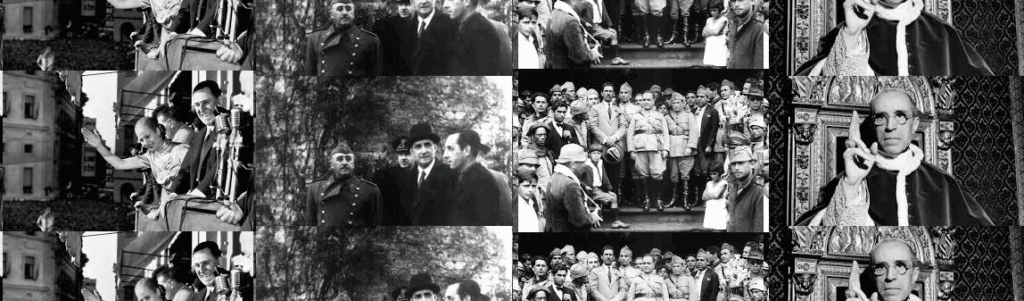
Nationalisms and populisms represent some of the most significant political and social phenomena shaping contemporary societies on a global scale. Despite a substantial body of scholarship on these topics, the connections with religious factors—especially when examined comparatively and transnationally—remain less explored, particularly during the crucial period of the Second World War and its aftermath. This project addresses precisely these gaps, investigating how religious actors, institutions, and discourses intersected with nationalist and populist dynamics across different contexts.
The CATO‑POPULISMOS project is a wide‑ranging scholarly initiative that mobilizes the newly opened Pius XII archives—released in March 2020 and covering the pontificate of Eugenio Pacelli (1939–1958)—to investigate how Catholic actors formulated, circulated, and interpreted ideas about nationalism and populism across Europe and Latin America. It examines how these debates took shape both within local Churches and within Vatican diplomacy. The project focuses in particular on the intersections between populism, nationalism, and Catholicism in Salazarism, Varguism, Francoism, and Peronism, exploring their ideological, cultural, pastoral, and political dimensions. More broadly, CATO‑POPULISMOS aims to analyze the role of the Catholic Church in relation to nationalist and populist movements in Portugal, Spain, Brazil, and Argentina. It also studies the language and resemanticization of devotional practices in these four contexts—both those encouraged by the Holy See (Marian devotions, Eucharistic worship, the social kingship of Christ) and those emerging locally, linked to national cults and, in some cases, to antisemitic elements within Catholic liturgy.
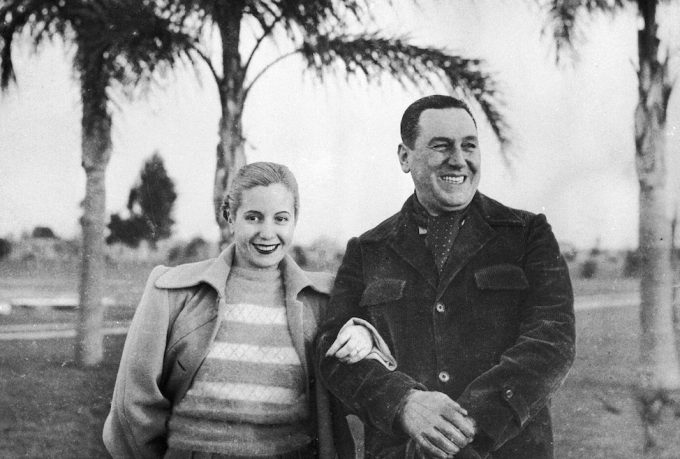
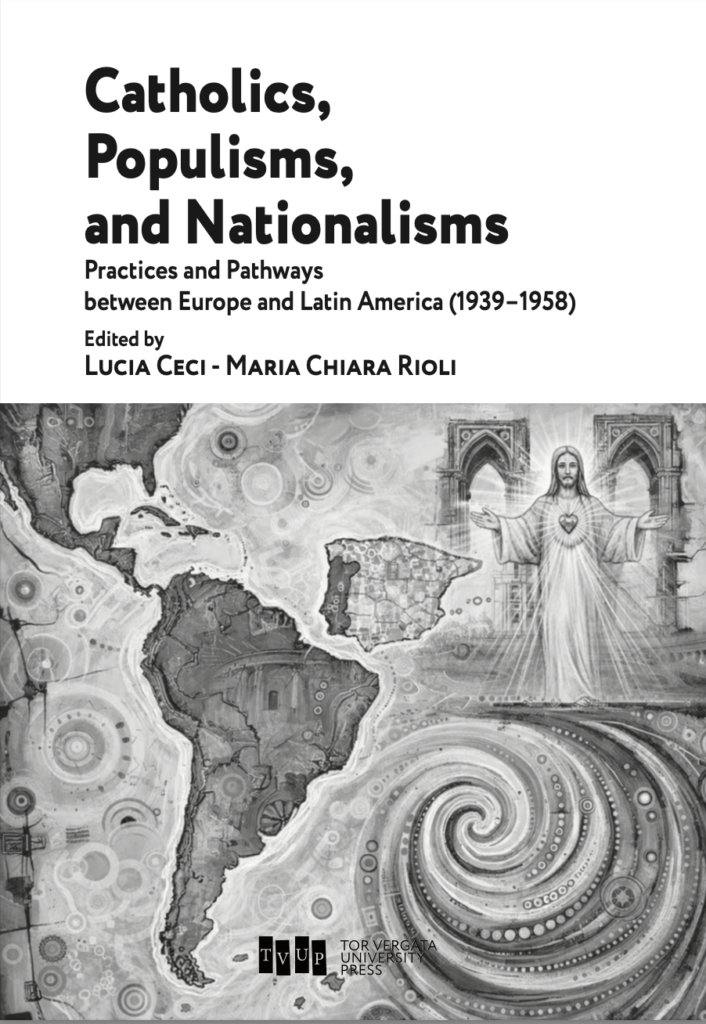
Published a few weeks ago by TVUP, this volume offers a fresh and rigorous contribution to the study of Catholicism, politics, and devotional cultures across Europe and Latin America in the twentieth century. Coordinated by Prof. Lucia Ceci and Prof. Maria Chiara Rioli, the book brings together a diverse group of scholars whose chapters explore institutional dynamics, transnational exchanges, and devotional practices through original archival research. From analyses of Brazilian Catholic responses to Vargas’ developmental populism, to studies of Church–State relations in Francoist Spain, Peronist Argentina, and mid‑century Catalonia, the volume maps a wide and interconnected landscape. Its publication reflects a collective scholarly effort and provides readers with a rich, multifaceted resource for understanding the complex pathways through which Catholic actors shaped political and devotional life.
The publication is open access and available here.
Our Research Team
Prof.ssa Lucia Ceci (Università degli Studi di Roma Tor Vergata)
Prof.ssa Maria Chiara Rioli (UniMoRe)
Prof. Alfonso Botti (UniMoRe)
Prof.ssa Maria Antonia Paiano (Università di Firenze)
Prof. Tommaso Caliò (Università degli Studi di Roma Tor Vergata)
Dr. Jacopo Pili (Università degli Studi di Roma Tor Vergata)
Dr. Nicola Riccardi (UniMoRe)
Dr.ssa Celina Albornoz (Università degli Studi di Roma Tor Vergata)
Conferences and Workshops
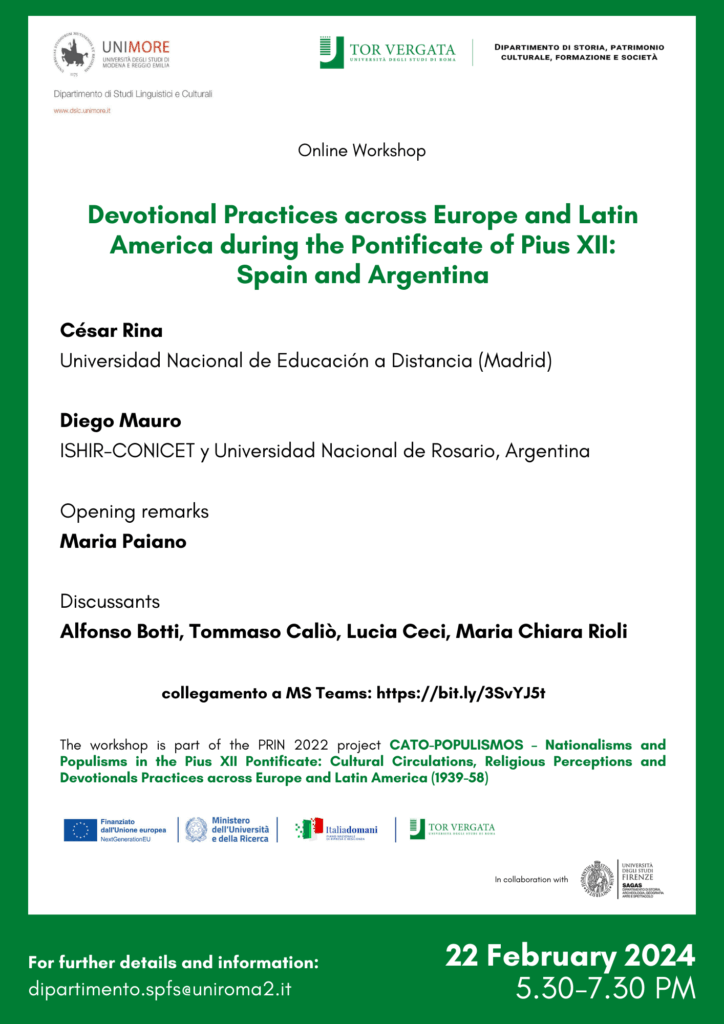
Online Workshop
Devotional Practices across Europe and Latin America during the Pontificate of Pius XIl: Spain and Argentina César Rina, Diego Mauro, Maria Paiano.
22 febbraio 2024
Online Workshop
National Populism in Brazil and Argentina during the pontificate of Pius XII Fabio Gentile, Daniel Lvovich
19 gennaio 2024
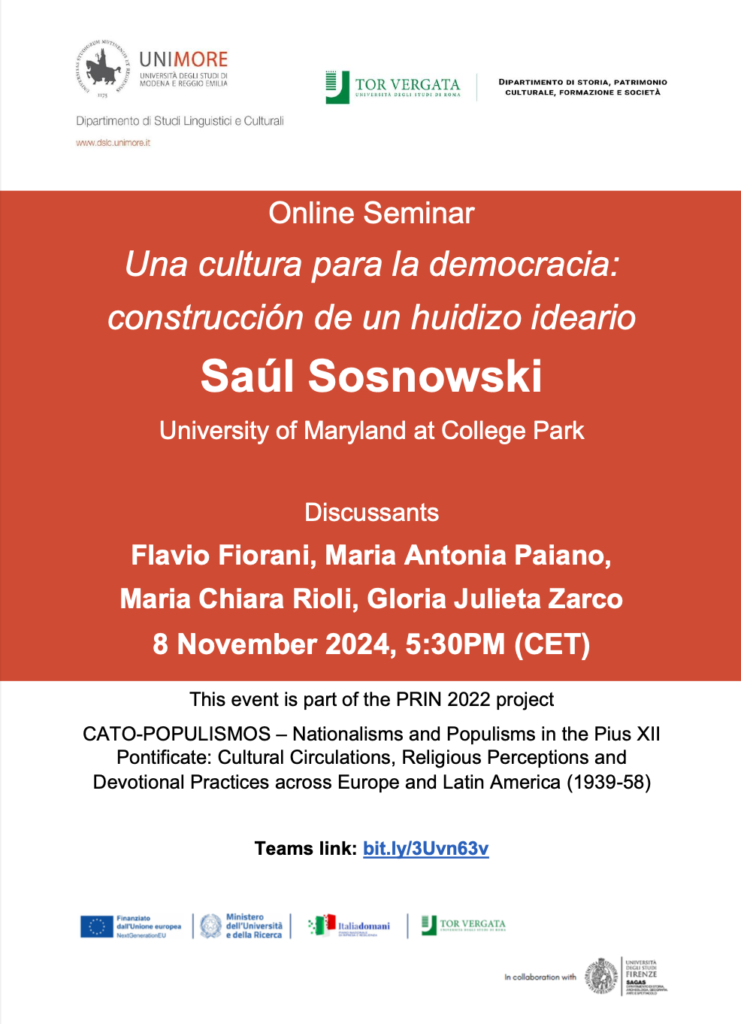
Online Workshop
Una cultura para la democracia: construcción de un huidizo ideario Saúl Sosnowski
8 novembre 2024
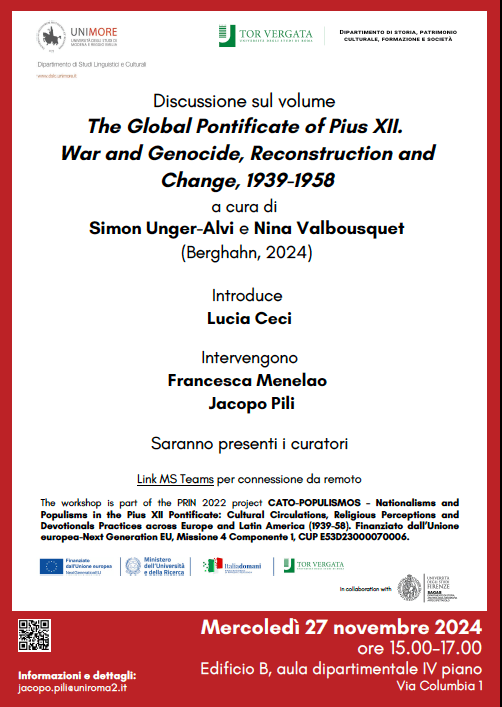
Book Presentation
The Global Pontificate of Pius XIl. War and Genocide, Reconstruction and Change, 1939-1958
Simon Unger-Alvi e Nina Valbousquet
27 novembre 2024
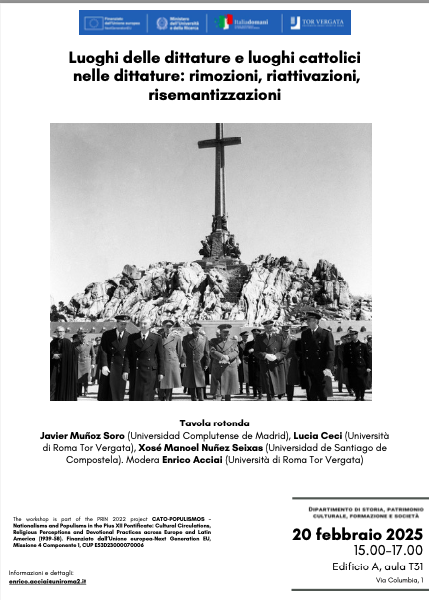
Round Table
Luoghi delle dittature e luoghi cattolici nelle dittature: rimozioni, riattivazioni, risemantizzazioni Javier Muños Soro, Lucia Ceci e Xosé Manoel Nunez Seixas.
20 febbraio 2025
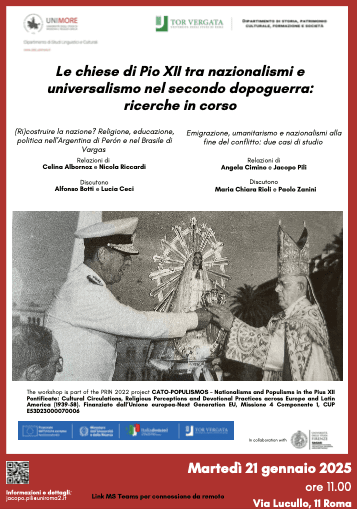
Workshop
Le chiese di Pio XII tra nazionalismi e universalismo nel secondo dopoguerra: ricerche in corso. Celina Albornoz, Nicola Riccardi, Alfonso Botti, Lucia Ceci, Jacopo Pili, Angela Cimino, Paolo Zanini e Maria Chiara Rioli
21 gennaio 2025
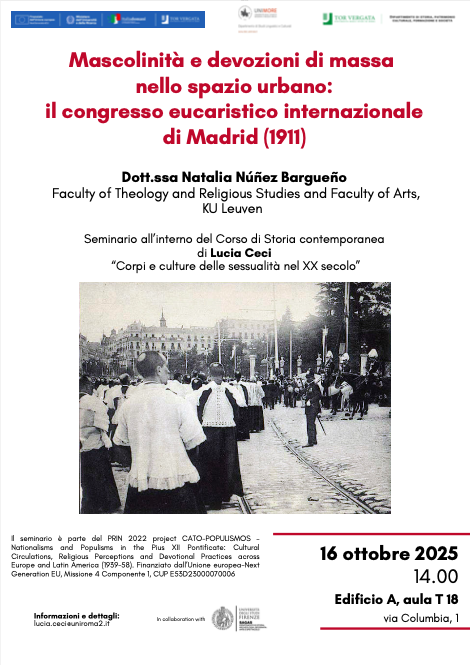
Workshop
Mascolinità e devozioni di massa nello spazio urbano:Il congresso eucaristico internazionale di Madrid (1911) Natalia Núñez Bargueño
16 ottobre 2025
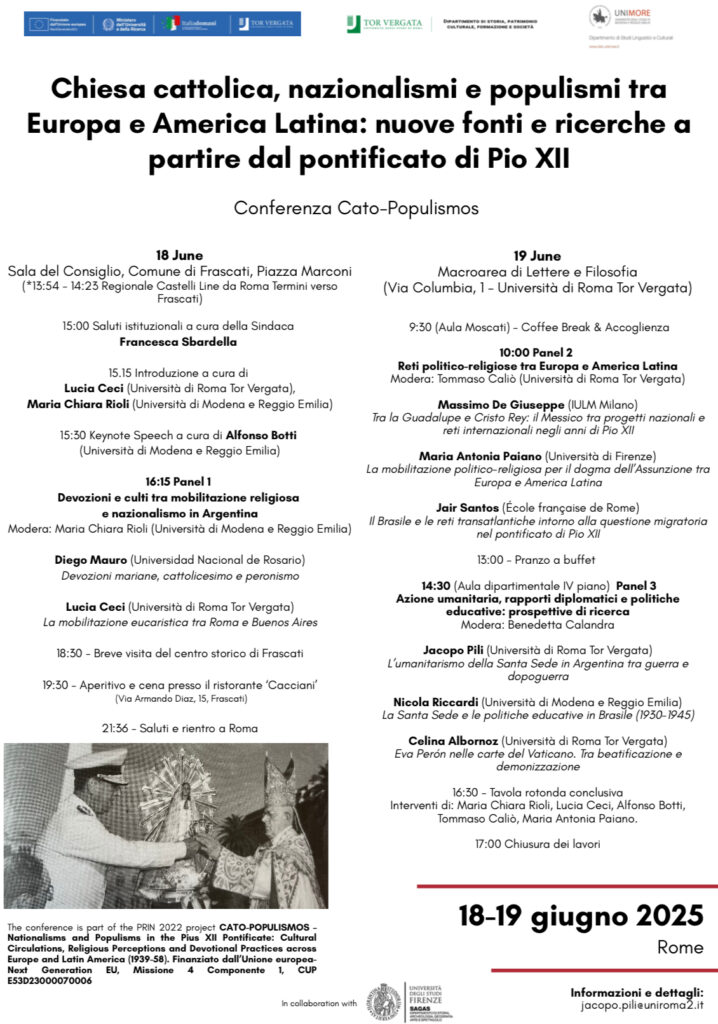
Final Conference
Chiesa cattolica, nazionalismi e populismi tra Europa e America Latina
Roma e Frascati, 18 e 19 giugno 2025.
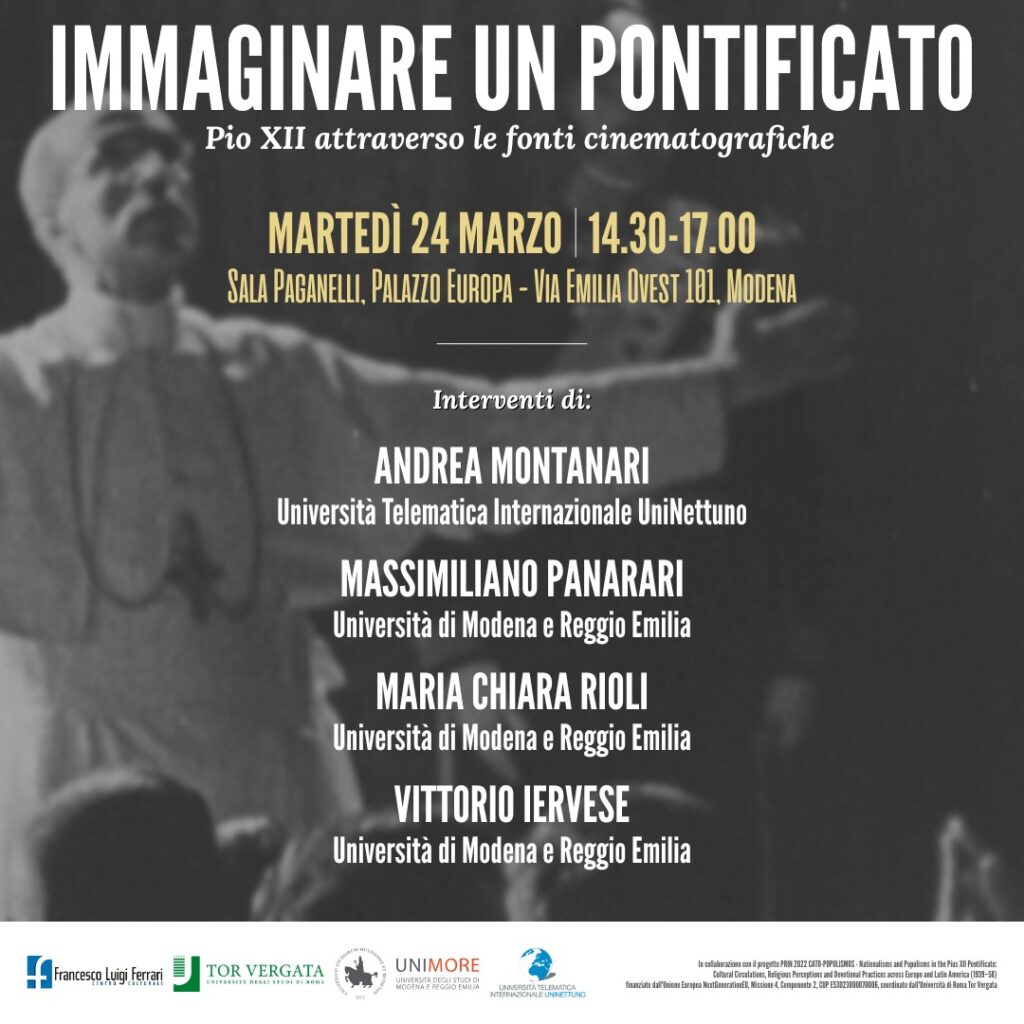
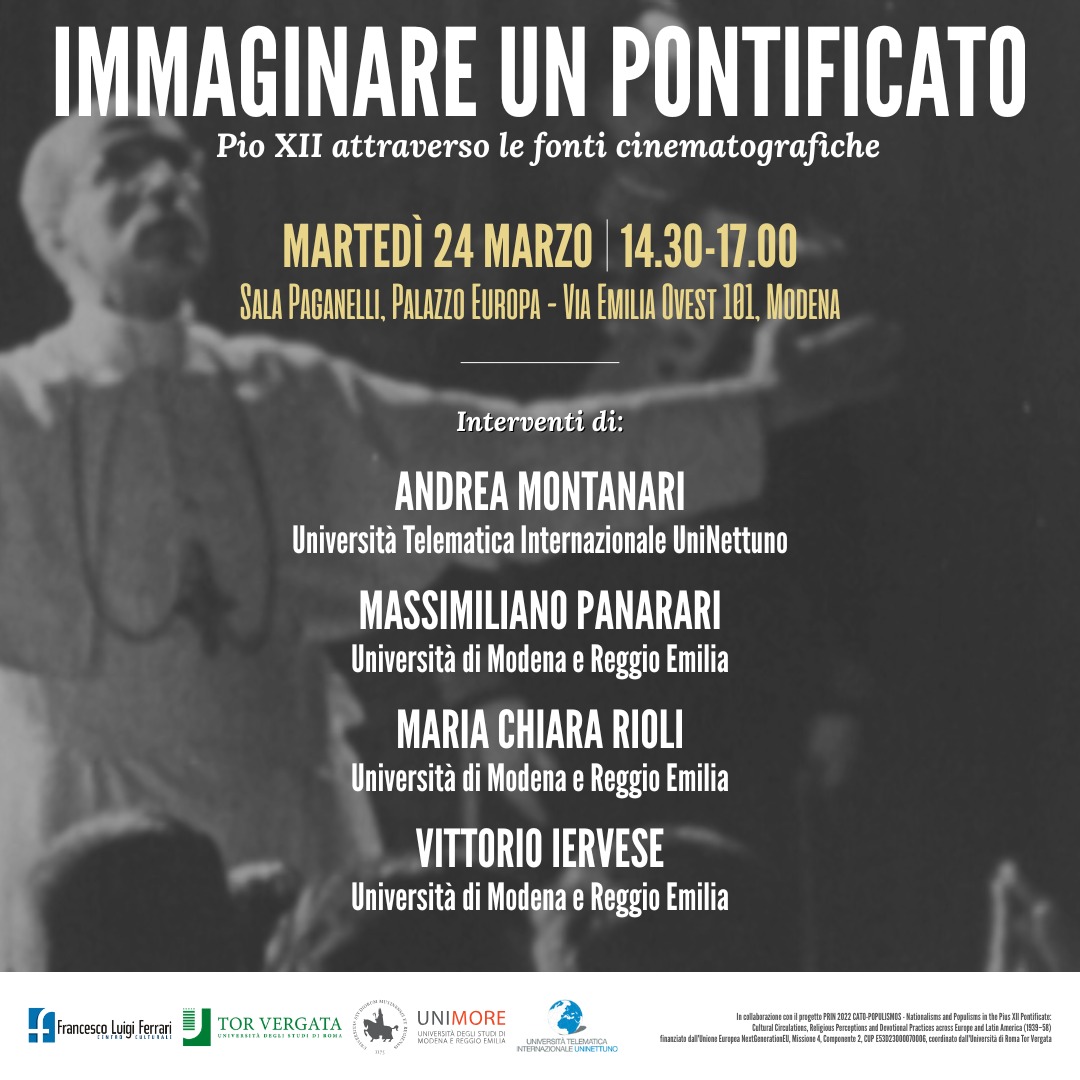
Seminario
Immaginare un Pontificato: Pio XII attraverso le fonti cinematografiche
Maria Chiara Rioli, Massimiliano Panarari, Andrea Montanari e Vittorio Iervese.
Centro Ferrari di Modena, 24 Marzo 2026.
Contatti
lucia.ceci@uniroma2.it
mariachiara.rioli@unimore.it
Catopopulismos
Questo sito web è parte del PRIN 2022 project CATO-POPULISMOS – Nationalisms and Populisms in the Pius XII Pontificate: Cultural Circulations, Religious Perceptions and Devotional Practices across Europe and Latin America (1939-58). Finanziato dall’Unione europea-Next Generation EU, Missione 4 Componente 1, CUP E53D23000070006
Dipartimento di Storia, Patrimonio culturale, Formazione e Società,
Università di Roma Tor Vergata.
Indirizzo:Via Columbia, 1, 00133 Roma RM

Dipartimento di Studi Linguistici e Culturali,
Università degli studi di Modena e Reggio Emilia,
Indirizzo: Largo Sant’Eufemia, 19, 41121, Modena MO